Bringing Machine Health into Focus: Why We Invested in IPercept
Turning a machine’s own motion into live, component-level insights.
Bringing Machine Health into Focus
Almost every physical product around us contains parts cut, drilled or milled on a CNC machine. Cars, aircraft, turbines, medical devices, consumer electronics: they all trace back to a machine tool on a factory floor. Together, these machines produce trillions of dollars of output every year.
Yet manufacturers often have limited visibility into the mechanical health of these machines. A failing spindle bearing or ball screw may only become apparent when parts start coming out of tolerance, or when the machine stops. Unplanned downtime remains one of the biggest drains on manufacturing productivity, and it has been for decades. Few problems in industry are this large, this well understood, and this unsolved.
That's why Isogon Ventures is proud to have co-led IPercept's $16.5M Series A alongside 2150, with participation from the company's existing investors.
Why Machine Health is Hard to Measure
It isn't for lack of trying. The obstacles are structural.
A typical factory runs machines from many different builders, each with its own controller, protocols and data formats. So any monitoring that relies on the controller has to be rebuilt for every brand on the floor. Even where connecting to the controller is technically possible, IT teams are increasingly locking down factory networks, because manufacturing has become one of the most targeted sectors for cyberattacks. Most importantly, controllers were designed to control motion, not to diagnose it. The data they produce simply isn't detailed enough to spot early mechanical wear on a specific component.
The missing piece isn't better software. It's better data from the physical world.
What IPercept Does Differently
IPercept, a spinout from KTH Royal Institute of Technology in Stockholm, went after the measurement problem directly.
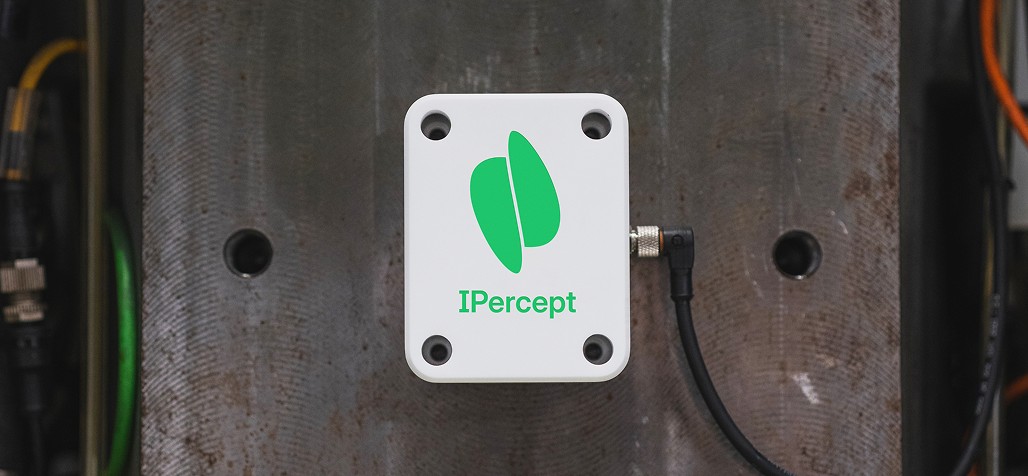
A single patented device, built on aerospace-grade motion sensors, is mounted at the spindle and moves with the machine. The machine then runs a short test cycle, and IPercept compares the motion it captures against a physics-based digital twin of how that machine should move when it's in perfect condition. The result is a component-level health report: which part is degrading, why, and how urgently it needs attention.
Three things about this approach stood out to us:
- It requires no connection to the controller or the plant's IT network, which removes the biggest barrier to deployment.
- It works on any brand, model or age of machine, from brand new to decades old.
- Because it's grounded in physics rather than in learning a machine's history, it delivers useful insight from the very first test, with no baseline period required.
Built on Years of Real-World Machine Data
Hardware can be copied. Years of labeled data from real machines failing in real factories cannot. IPercept has been building that dataset since before the company was founded, across dozens of machine brands and more than a dozen countries, and it grows with every deployment. It now trains the models behind the product, and each new machine makes the system better for every customer.
We see this as the foundation for something bigger than predictive maintenance. The same device and data layer already supports new applications, from process monitoring to utilization tracking, activated remotely without any new hardware. Over time, we believe IPercept can become the data layer that makes AI on the factory floor actually work.
The Team
From our very first meeting, Karoly stood out. He holds a PhD in CNC diagnostics from KTH and is the inventor behind IPercept's core technology, but what stayed with us after that first conversation was his energy and the sheer scale of his ambition. He doesn't just want to build a better monitoring tool, he wants to set the new standard for predictive maintenance in manufacturing. And he has the work rate to match. Fittingly for someone who has spent his career studying machine tools, Karoly himself is something of a machine.
When we met the broader team, it became clear that this energy is contagious. Around Karoly is a group that combines deep machine-tool expertise with serious commercial experience in industrial services, including leaders who have run the very type of service businesses IPercept now sells through. They share his conviction, and it shows in how they work with customers and partners.
IPercept's Next Chapter
We invested in IPercept because the team is applying deep technical expertise to a significant manufacturing problem—a practical example of the physical AI we focus on at Isogon. Its roots at KTH and the team's experience in the industry give it a strong foundation for the work ahead.
The next chapter is about bringing the technology to more manufacturers, building on existing customer deployments and service partnerships as the company expands across Europe and into the U.S. We look forward to working with Karoly and the team, drawing on our industrial network to help build new customer and partner relationships.
Welcome to the Isogon portfolio, Karoly and team. The machines have been waiting long enough.